
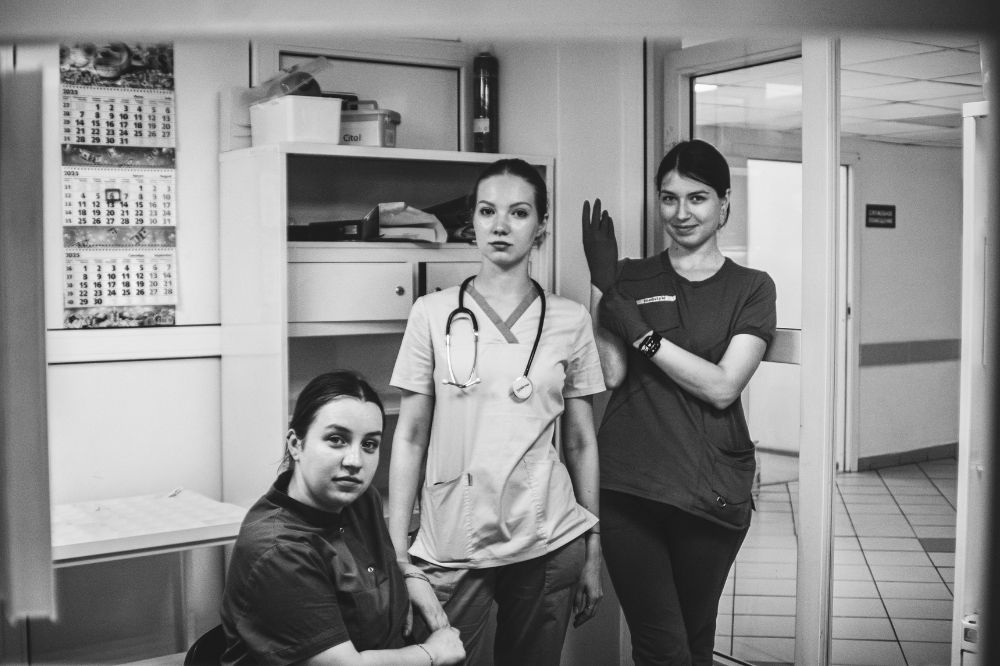
Students researching healthcare careers often encounter job titles, salary tables, and education requirements before they understand what the work feels like. Those details may describe a healthcare career pathway, but they rarely show how clinical responsibilities, patient contact, and workplace routines shape an ordinary shift.
The more useful question is what students can learn about themselves and the field by getting close to patient care before committing to a degree. Hands-on exploration makes the expectations of clinical work visible, including its boundaries, pressures, and interpersonal demands. It can reveal whether a student is comfortable in the environment while building skills that remain useful across different educational and career directions.
What Hands-On Healthcare Work Looks Like Daily
A morning shift might begin with checking vital signs, helping a patient sit upright, collecting a specimen, and preparing another patient for transport. Hands-on work usually consists of these repeated, short interactions, where bedside manner matters as much as technical accuracy.
Documentation follows each task rather than functioning as separate work. A correct venipuncture loses its value if the tube is mislabeled, while late or incomplete charting can disrupt the next handoff among entry-level staff, nurses, technicians, and physicians.
The work also has firm boundaries. A defined scope of practice determines which tasks workers can perform, who supervises them, and when they must escalate a concern. Infection control shapes everything from hand hygiene to equipment disposal. As a result, clinical training experiences reveal work built on consistent routines rather than dramatic procedures.
Short Training Paths Into Direct Patient Care
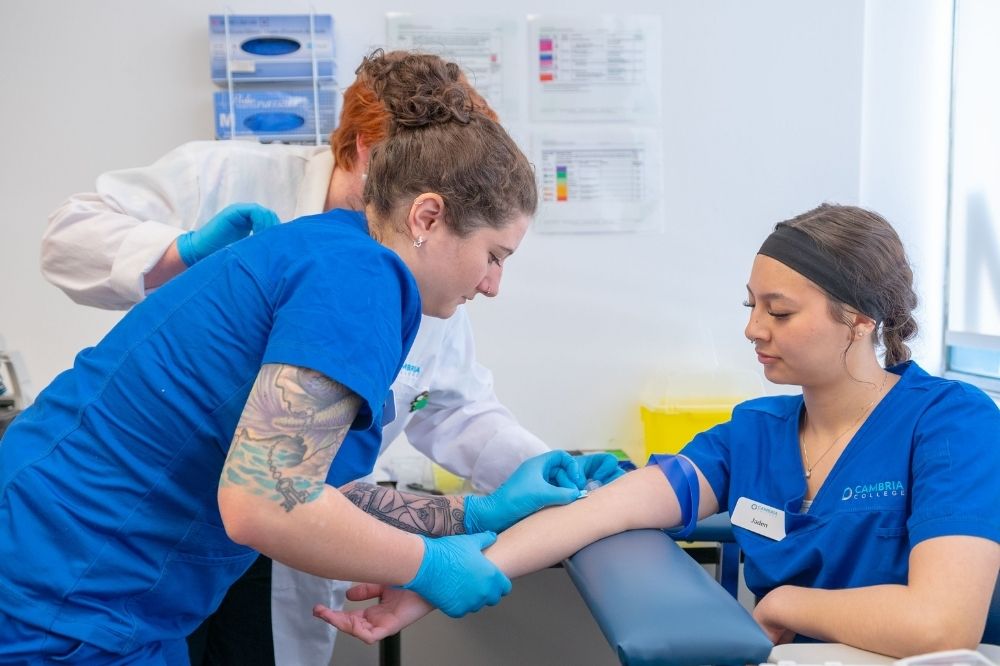
Short-training roles give students a practical path into patient care without requiring an immediate commitment to a multi-year degree. Programs may run for weeks or months, but their shorter duration does not remove the need for technical instruction, supervised practice, and formal assessment.
Phlebotomy and Patient Care Technician Roles
Phlebotomy training concentrates on venipuncture, positive patient identification, specimen handling, labeling, and safe disposal. Drawing blood is only one part of the process. Students must also select the correct collection tube, prevent contamination, reassure nervous patients, and preserve the specimen during transport.
Training commonly leads to a certification exam with written and practical components. Written exams, according to PhlebotomyPracticeTest.net, assess order of draw, tube additives, patient identification, and safety protocols. Practical assessment tests whether students can perform the procedure in the correct sequence. Structured phlebotomy test prep therefore covers knowledge that repetition with a needle alone will not teach.
A patient care technician has a broader bedside role, often in a hospital. Typical responsibilities include recording vital signs, assisting with mobility and hygiene, performing permitted basic procedures, and documenting changes for the nursing team.
Medical Assisting, CNA, and EMT Routes
A medical assistant generally works in an outpatient clinic, combining patient intake and basic clinical tasks with records and scheduling. The position involves frequent movement between examination rooms and administrative work.
A certified nursing assistant (CNA) spends more time providing direct bedside care in long-term or acute-care settings. Feeding, bathing, repositioning, mobility support, and reporting changes are central duties. An emergency medical technician (EMT), by contrast, assesses patients in the field, provides care within a defined protocol, and supports transport.
These settings create different pressures even when training lengths appear similar. Official occupational information allows students to compare roles, training requirements, and employment outlooks rather than treating every short clinical program as interchangeable.
Skills That Transfer Wherever Students Land
A credential documents completed training, but it does not capture everything learned through patient contact. Direct-care work also develops habits, judgment, and self-knowledge that remain useful when students change roles or continue along a healthcare career pathway.
Habits Built in Front of Patients
Explaining a procedure to a frightened or uncomfortable patient teaches communication under pressure. Bedside manner develops through repetition, including noticing hesitation, adjusting an explanation, protecting privacy, and remaining calm when a routine interaction becomes difficult.
Precision also becomes measurable. A mislabeled tube has a traceable consequence, just as a missed vital-sign check leaves a gap in the clinical record. Accordingly, students learn to manage time without treating patients as items on a task list.
Infection control changes from memorized terminology into practiced behavior. Hand hygiene, clean work surfaces, protective equipment, and correct disposal become part of how each task begins and ends. Those habits carry into later clinical rotations because they no longer depend on recalling a classroom list.
Hands-on work can also reveal an unsuitable fit. Discovering discomfort with bodily fluids, repeated close contact, or distressed patients counts as useful learning rather than a wasted year.
Stepping Stones Toward Nursing and Imaging
Early patient-facing work gives students a clearer reference point for later study in nursing, imaging, laboratory science, or another pre-health route. Anatomy and procedure lessons become less abstract after students observe how patients move through a clinical setting.
Documented experience can also support applications when programs value or require patient-contact hours. However, early employment should not automatically delay prerequisite courses. It works as a stepping stone when shifts leave enough time for academic requirements and future clinical rotations.
How to Test Interest Before Enrolling
Testing interest before paying tuition reduces the cost of changing direction later. Useful exposure shows both patient-facing work and the surrounding routines, including documentation, shift handoffs, and cleaning procedures.
Low-Commitment Ways to Get Close to the Work
Job shadowing offers a focused view of how a professional organizes a shift and communicates with patients. Hospital volunteering provides less clinical responsibility, but it still exposes students to unit routines, infection control expectations, and the pace of patient care.
Nonclinical jobs, such as patient transport or unit clerk work, offer longer exposure. Transport workers see how mobility, scheduling, and handoffs affect care, while unit clerks observe communication among departments without performing clinical procedures.
High school health science programs can add simulations and basic skill practice. Earlier hands-on STEM exploration also helps distinguish an interest in applied science from an interest in direct patient care. Informational interviews with working technicians can then provide details that course descriptions omit.
Constraints Students Should Weigh Honestly
Hospital-based roles commonly include nights, weekends, and holidays. A student who can manage the procedures but cannot sustain rotating shifts may have identified a setting mismatch rather than a mismatch with healthcare as a whole.
Physical demands also shape fit. Direct-care workers spend long periods standing, assist with movement and positioning, and repeat tasks throughout a shift. Emotional strain can come from contact with pain, confusion, fear, and family distress.
Training access has practical limits as well. Clinical rotations may depend on completed health records, immunization or TB screening requirements, criminal background checks, and available placement sites. Delays in these areas can postpone completion even after classroom work begins, so timing depends on more than the published course calendar.
Treating Exploration as the Real Lesson
The central question is not which entry-level role is universally best. Instead, it is what students learn by getting close enough to understand the work’s routines, boundaries, pressures, and human demands. That knowledge makes a healthcare career pathway more concrete than a job title or course description can.
Exploration produces two useful outcomes. A confirmed fit provides relevant habits and a clearer starting point for further training. Alternatively, a poor fit allows an early, relatively inexpensive correction before years of study are built around assumptions about clinical work.
